Certification: modeled odds against a real prop-firm evaluation
Certification replays your strategy against a specific evaluation's rules — profit target, daily loss limit, trailing vs static drawdown, time limit — thousands of times, stepping trade by trade, and reports the modeled pass odds.
Certification opens after a ROBUST Perturbation and a Robustness run
A setting is certified only after it has passed through the whole crucible. The Certify button appears on a Robustness result once a Perturbation of that exact setting has come back ROBUST; until then the page says which stages have run, which verdict is blocking, and what to do next. A setting the Perturbation stage called sensitive or a cliff edge is not certified: its profit does not survive small changes to its own parameters, so a pass probability built on its trades would be precise-looking and weak. The usual route to a real plateau is more history: extend the date range and re-run the chain. "Review with a fresh backtest" on the optimization leaderboard is a look at a setting, not a test of it, and does not open certification. The chain that does: Audit this setting, then Perturb, then Robustness. The app refuses a certification started any other way, with the same explanation. Imported trade records and campaigns are judged on their own rules and are not affected.
Enter your firm's rules
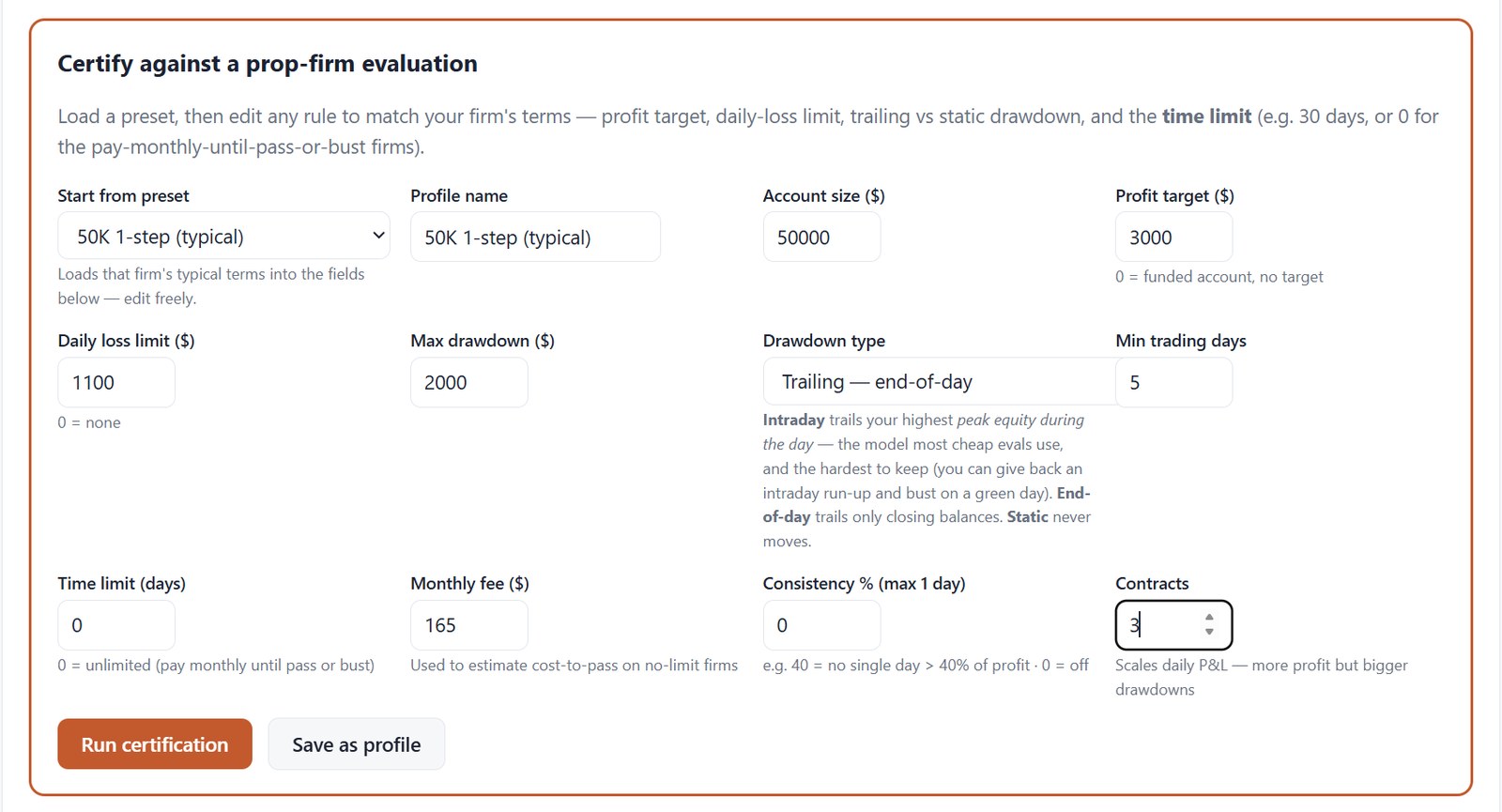
Load a preset, then edit any rule to match your firm's current terms. Presets are generic models of common industry structures, not the official rules of any firm — always verify terms directly with your firm.
Read the answer with its costs
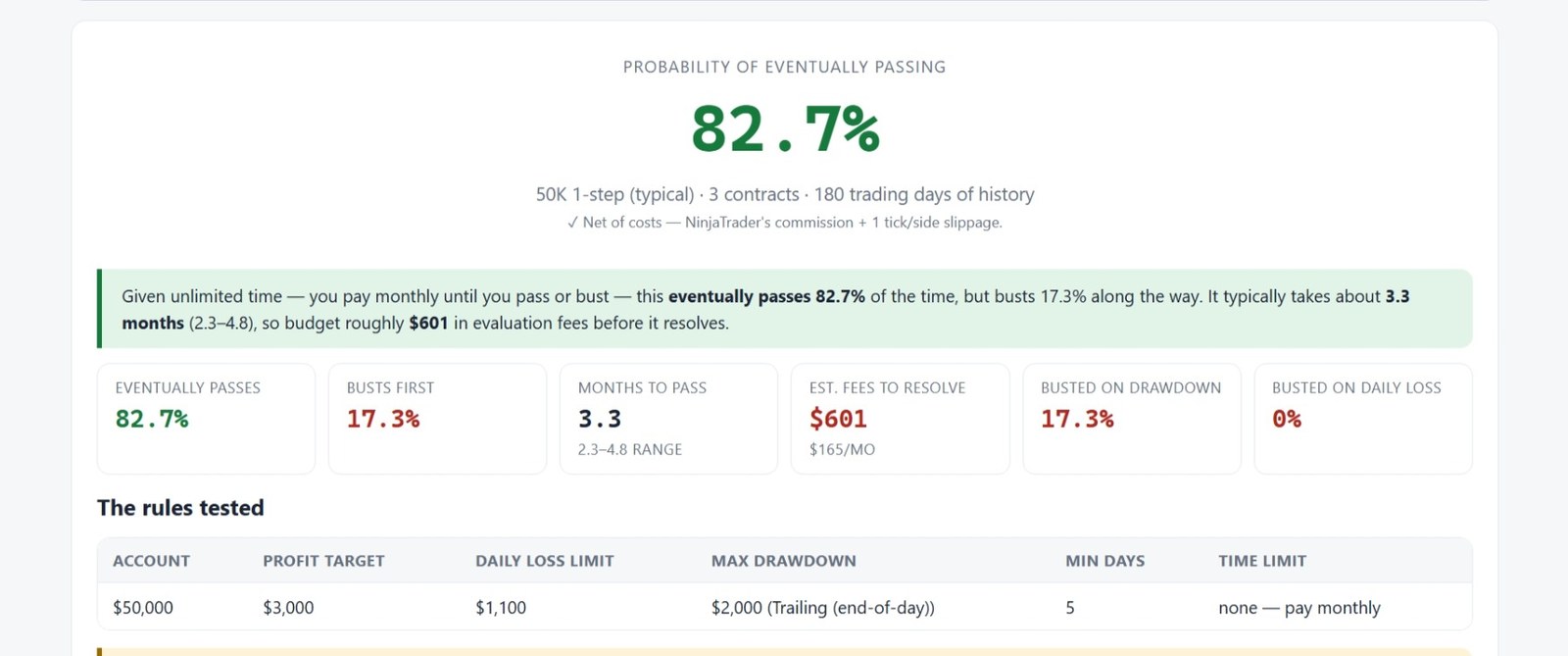
The headline is the modeled probability of eventually passing — but read the whole row: the bust rate along the way, the typical months to resolve, the estimated evaluation fees, and which rule does the busting (trailing drawdown vs daily loss). Know this before paying for an eval, not after.
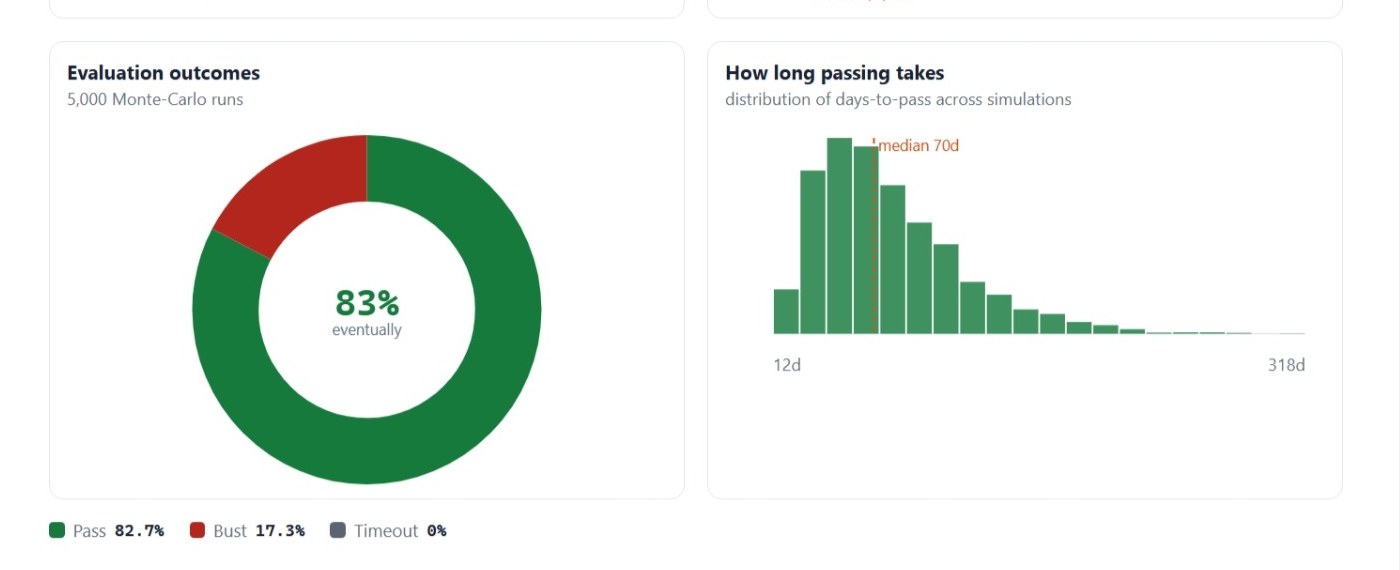
The days-to-pass distribution sets expectations: what a normal month looks like, and how long is long enough to suspect something has changed.
When the record no longer describes the strategy
The pass odds are computed from the whole history — and a strategy can be profitable over the whole history while having stopped working. Before certifying, AlgoCrucible splits the record into everything before the last six months and the last six months. If the earlier part made money and the recent tail lost money, the certificate is stamped NOT CERTIFIED and export is blocked, with the two halves shown side by side: what it earned before, what it lost since. A certificate for that strategy would describe a thing that no longer behaves like its own record. (Too few recent trades to judge is said plainly, and doesn't block.)
The certificate
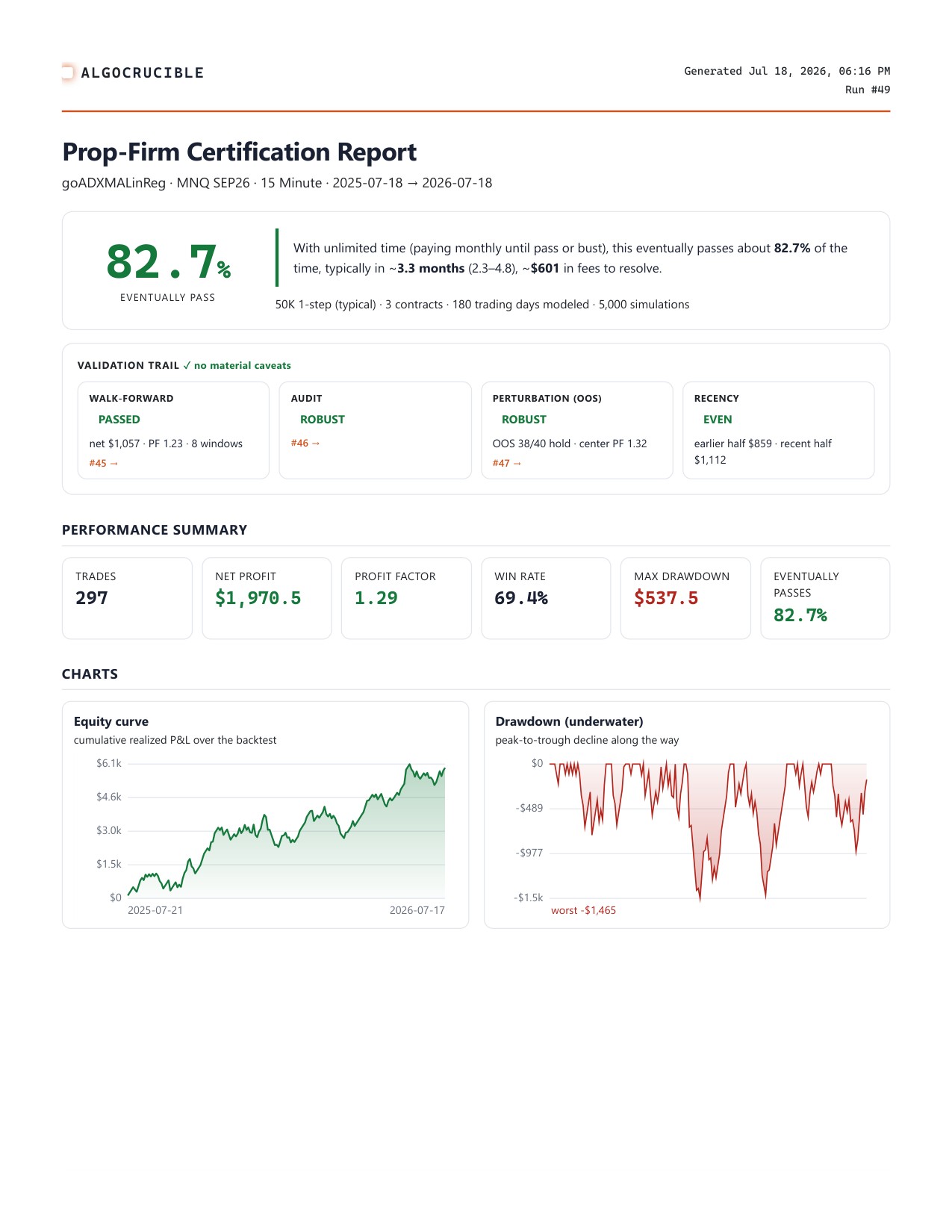
Open the full report → Save as PDF (or Print) — and say yes when it offers the full parameter settings, so the certificate states every input the run used. Every stage's verdict on one page: walk-forward, audit, perturbation, the exact rules tested, and the modeled pass odds — with the methodology and its limits stated on the document.
Every report names the app version that produced it, in the masthead beside the run number and in the footer. A certificate also carries one line naming the rule it was issued under: after a ROBUST perturbation and a robustness run on the setting, or on an imported record, or by a campaign, or for a portfolio. A certificate made before that rule existed says so, since it could rest on a perturbation that was not ROBUST.
A certificate is also re-judged against the current rule every time it is opened. One issued before the rule, or resting on a perturbation that was not ROBUST, is stamped "not certified under current rules" in the same red band a robustness failure gets, and it cannot be exported as a clean certificate. The validation trail on the sheet only ever shows runs on the same product: a certificate for one market never borrows another market's walk-forward, and it says plainly when no walk-forward has run on its market.
Hold back the last weeks before you start
The run form has a "Hold back the last N weeks" control, set to two weeks by default. Those days are kept out of every stage of the run and of the runs continued from it: the optimization never scores them, the walk-forward and audit never test on them, and the certification never counts them. A setting that reaches certification has therefore never seen them, and when you put it into the tracker, its first check on fresh data can run straight away on those two weeks instead of waiting a month for new ones. The run log says which days were held back. Set the control to 0 to use the whole range.
After you pass
Passing an evaluation starts a different job: running funded accounts day to day — copying trades across them, tracking each firm's rules and payouts. We don't build that; PropFirmConnector does, and lists AlgoCrucible among its recommended validation tools. Code ALGOCRUCIBLE100 takes $100 off a Lifetime license ($10 off each month on Monthly). Disclosure: that's a partner link — we earn a commission if you buy through it. It changes nothing about your price beyond the discount, and nothing about what this app tells you about your strategy.
These figures are hypothetical, model-based estimates — not a prediction or guarantee that any strategy will be profitable or that any evaluation will be passed. A pass estimate does not guarantee passing any firm's evaluation or keeping any funded account.