From two validated strategies to a portfolio you can live with
The certification walkthrough ends with one strategy and a
prop-firm certificate. This one ends with a book: two real NinjaTrader 8 strategies on two instruments
(WebinarTisHmaSlope on MNQ, goAlgoBosChoChStrategy on MGC), tested as a
combination, held to rules you write. Every screenshot is from those runs.
Before you read the numbers: everything below is hypothetical,
model-based simulation — not a prediction or guarantee. Backtested results have inherent limitations,
past performance does not indicate future results, and trading futures carries a substantial risk of
loss. This walkthrough shows how the tool interrogates a combination of strategies; it is not a
claim that any strategy or portfolio makes money. Full guide · see the
disclaimer in every report.
1/The question a portfolio answers
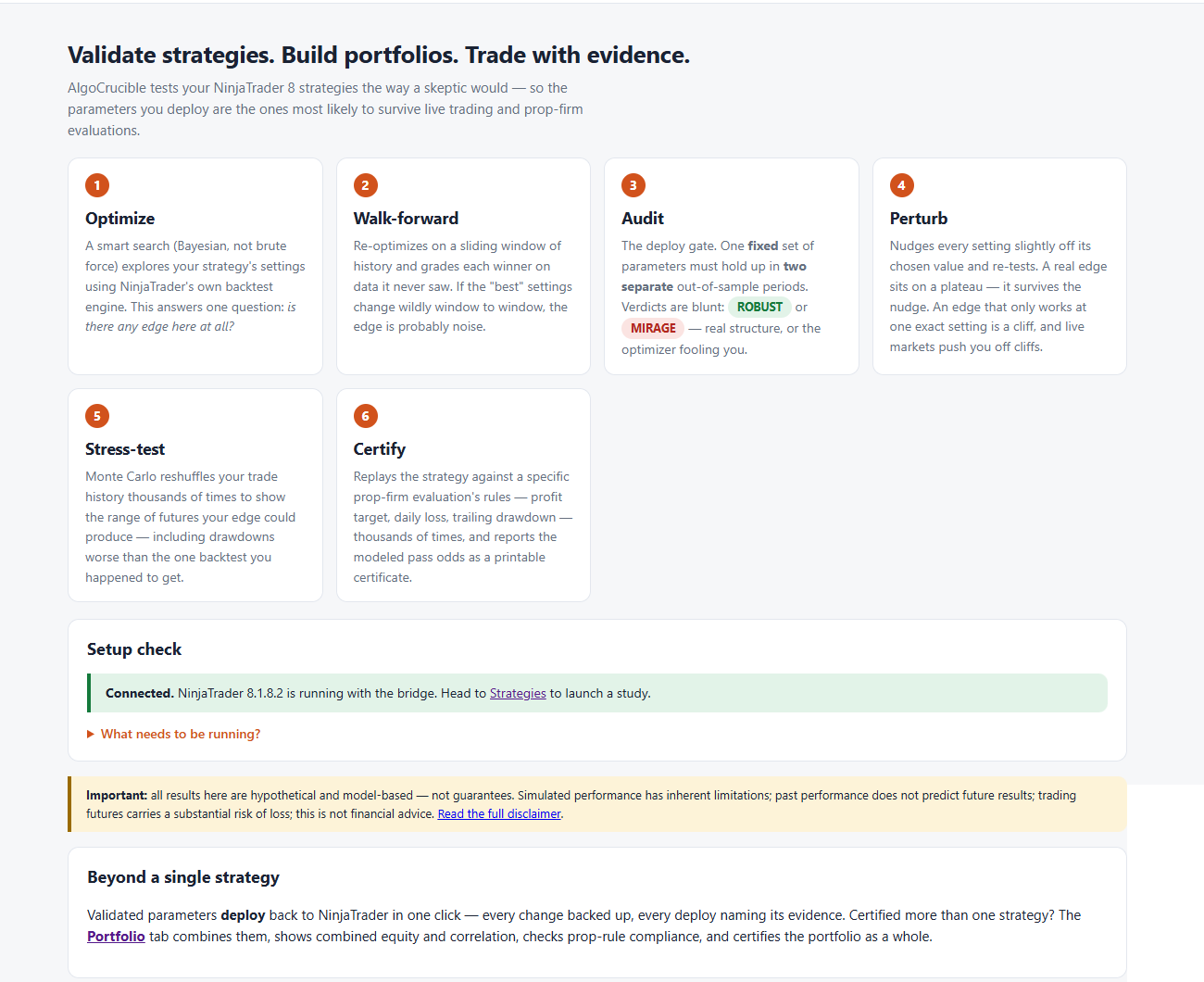
Six stages, then a fork. The prop-firm route ends in a certificate; this route ends in a portfolio you
intend to sit through drawdowns with. The validation underneath is the same — Optimize, Walk-forward,
Audit, Perturbation — the difference is who sets the rules at the end. A prop firm's evaluation
has a target, a daily loss limit and a trailing drawdown. Your book has the drawdown you would actually
tolerate, the months underwater you would actually wait out, and the diversification you actually need.
Two destinations. Same funnel, different ending. The certificate says
"this strategy's history would have passed that firm's rules N% of the time." The portfolio says "this
combination, held to my rules, would have stayed inside them N% of the time."
2/Two members, validated separately
Two strategies on two instruments. Each must earn its place on its own before they are allowed to share
a book: an optimization, a walk-forward, an audit on two held-out periods and a perturbation of its
settings. That per-strategy work is the whole of the certification
walkthrough; here we pick up where it ends.
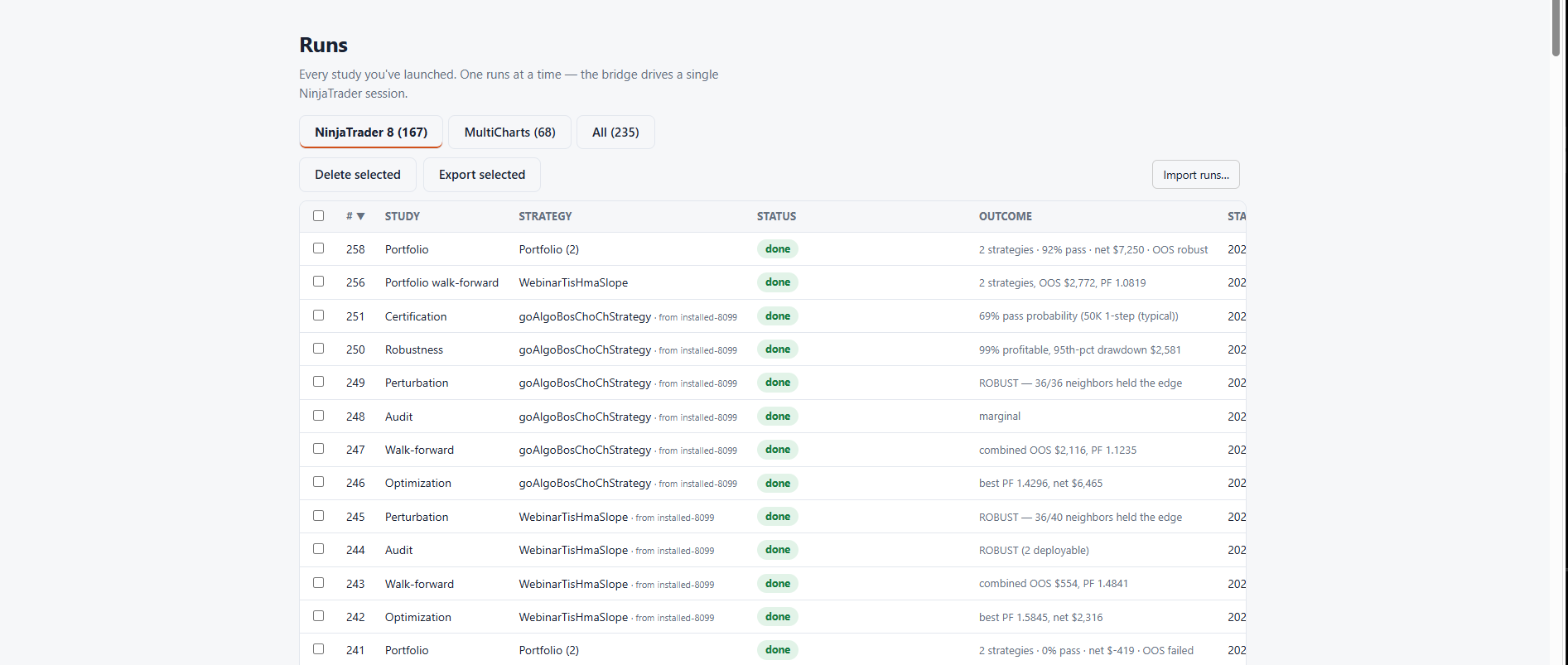
Two chains.WebinarTisHmaSlope on MNQ, 15-minute bars, and
goAlgoBosChoChStrategy on MGC, 5-minute bars. Both reached a ROBUST perturbation verdict
— the one thing the portfolio page will insist on later. Validated on a laptop? Runs move between
computers from this page (Export selected / Import runs), and a paid plan covers more
than one machine.
3/Portfolio walk-forward — is the combination worth building?
Before freezing anything, ask whether these two have a joint edge on data nobody tuned on.
A portfolio walk-forward is each member's own walk-forward plus a merge: every member enters as a search
space, not a setting; every window re-optimizes it and trades the result on the next window; then the
out-of-sample trades of all members are laid on one calendar. Members that already have a finished
walk-forward are reused as-is — the merge takes seconds and needs no engine.
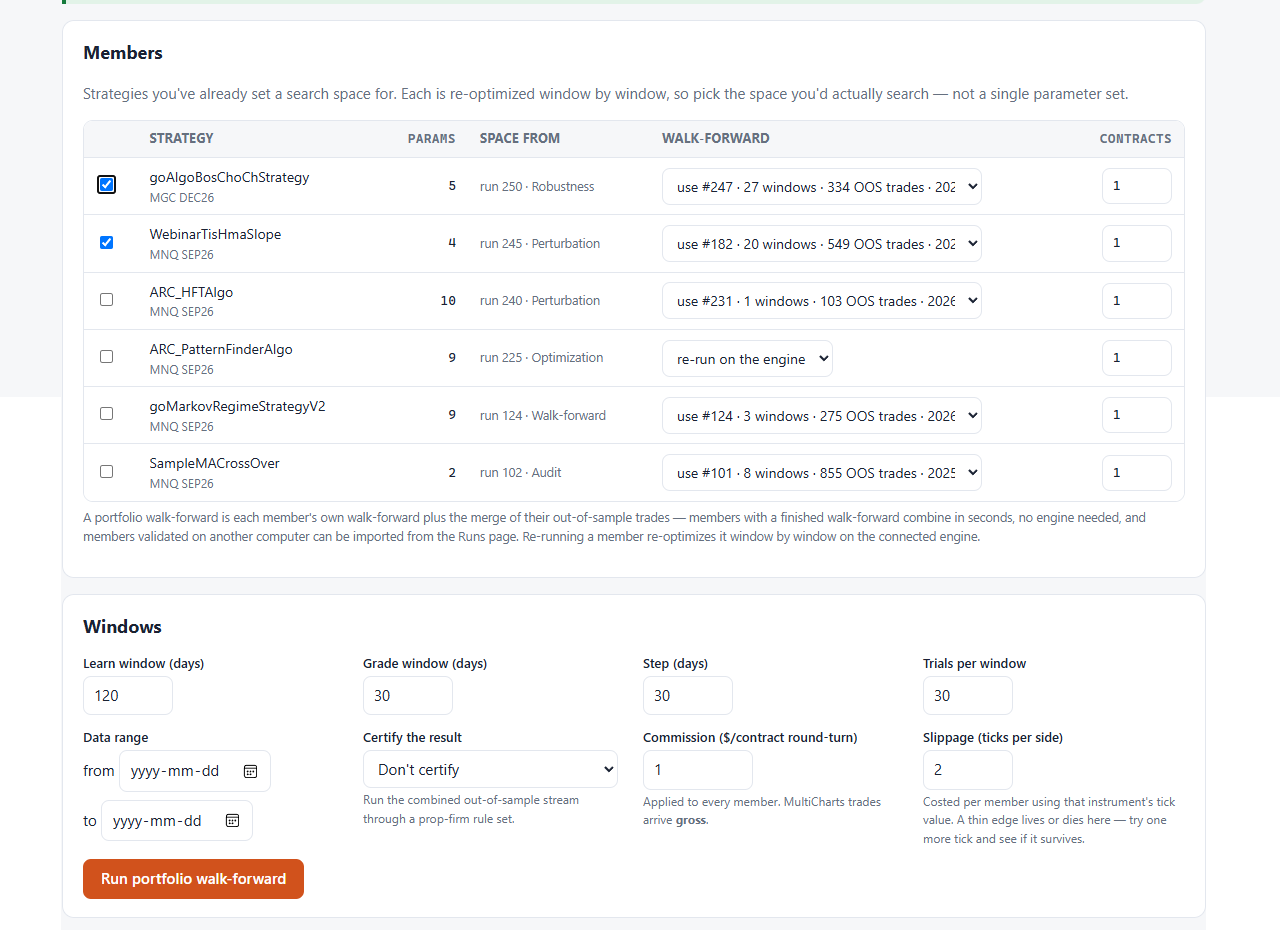
Each member enters as a search space. Learn 120 days, grade 30, step 30.
The Walk-forward column either reuses a finished run (#182: 20 windows, 549 out-of-sample
trades; #247: 27 windows, 334) or re-runs the member on the engine. Every trade you are about to see
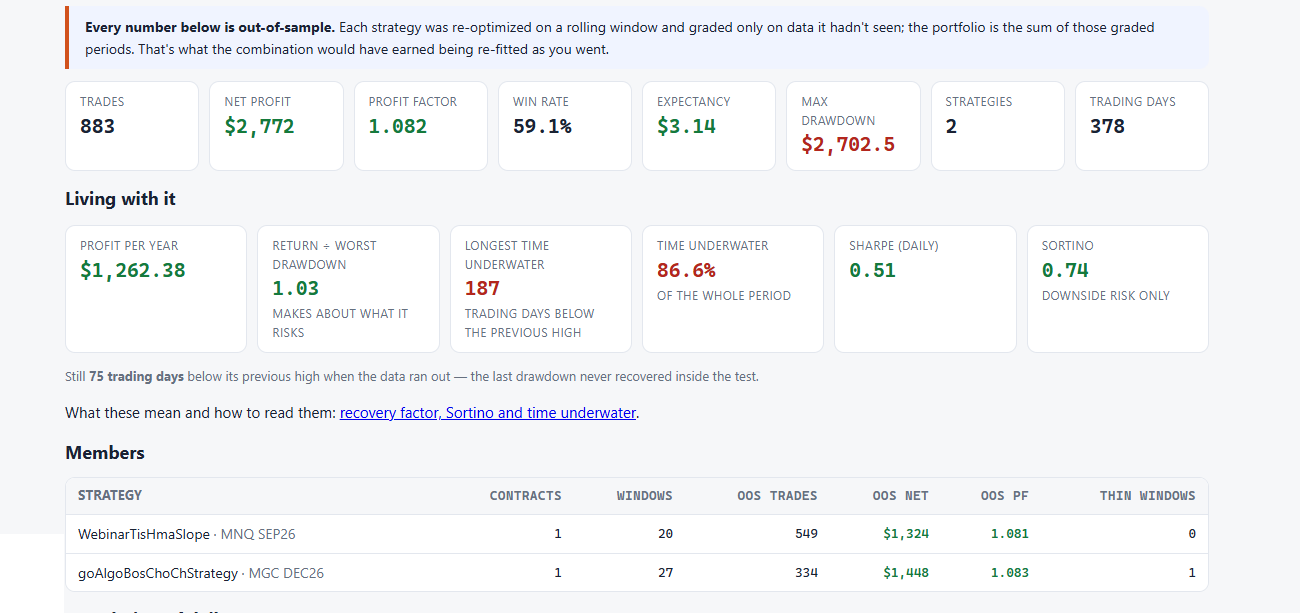
came from data the optimizer hadn't seen.The combined out-of-sample curve. Joint period 2024-10-29 to 2026-06-17 —
the span both members were tested on, stated on the screen. 883 trades, net +$2,772, profit
factor 1.08, worst drawdown $2,703. This is the honest answer to "do these two have a joint edge?" —
and it is not a setting you can trade. What it validated is the procedure "re-optimize every
30 days and trade whatever comes out."
4/Correlation measured out-of-sample
Correlation on one hindsight-fitted history flatters everything. Here it is measured on the
out-of-sample trades only — the days each member actually earned while trading settings it had not
been tuned on.
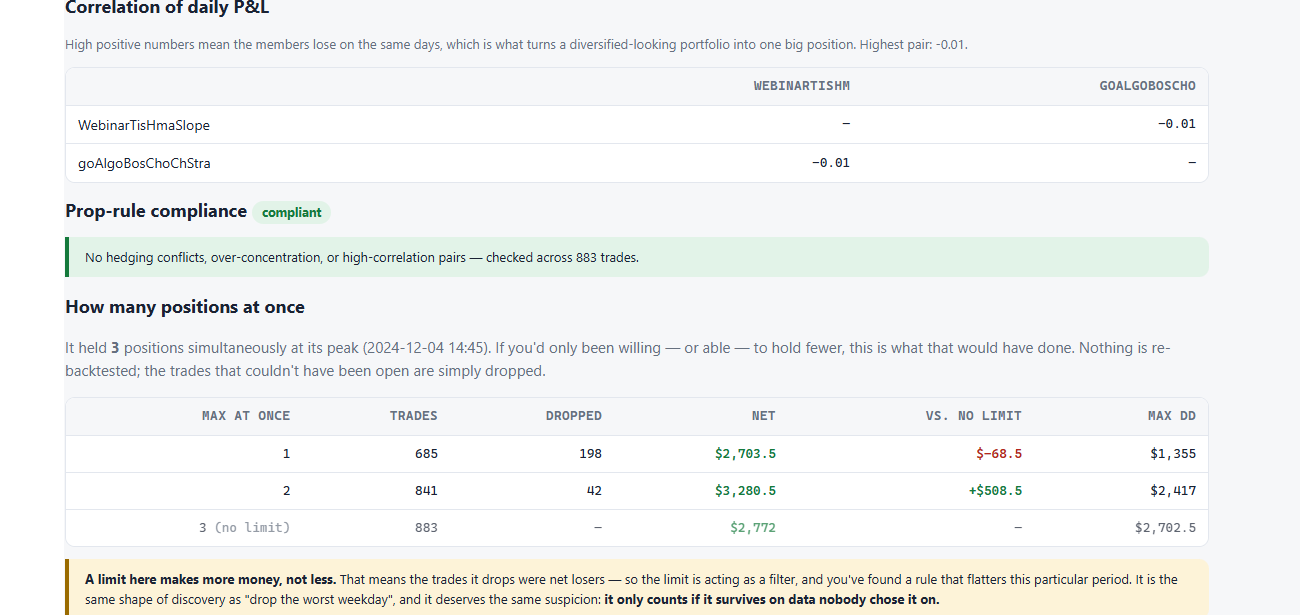
−0.01. Low is the whole reason to hold both: one's drawdown is the other's
ordinary month. The overlap count underneath says how often they were in the market at the same time
— and the conflict scan says how many hours they were long and short the same contract family at
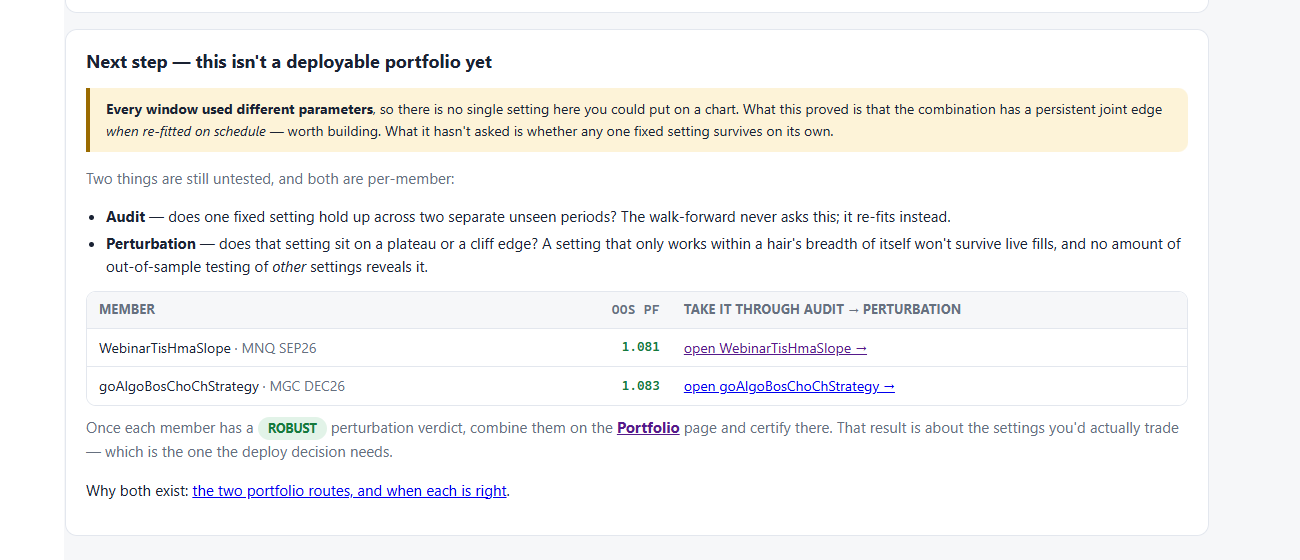
once (here: none).The app says it on the screen. A walk-forward validates a procedure. A
portfolio you trade needs each member frozen at one setting that survived Audit and Perturbation —
so the next step routes you to the members, not to a Deploy button. The tail check — the last 35% of
the period graded on its own — came back marginal, which is worth knowing before Part 6.
5/Earning membership
The fixed portfolio has one entry rule: a strategy joins at a specific setting, and that setting must
have passed Perturbation with ROBUST. Not "optimized well". Not "audited marginal".
The neighbours of the setting held the edge out-of-sample, or the strategy stays out.
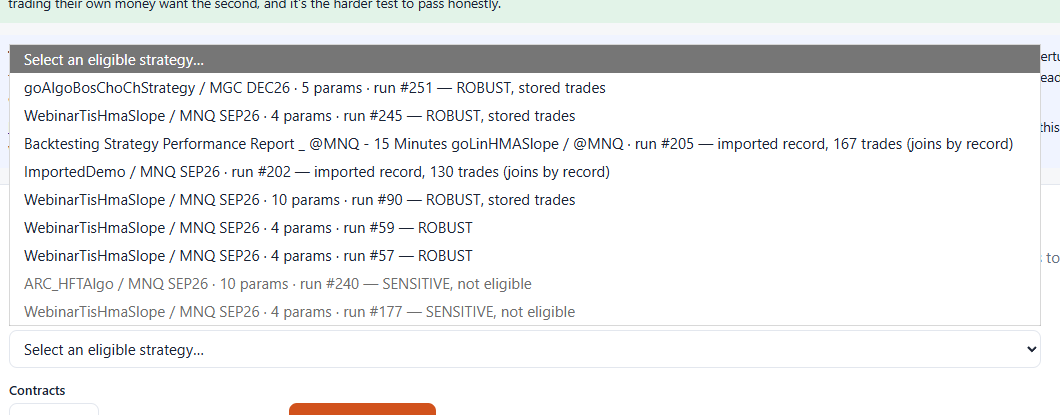
Only ROBUST gets in. The greyed entry had a profitable optimization and
still isn't allowed in — its settings sat on a cliff edge, and a portfolio built on a mirage certifies
a mirage. A member that stored its trades joins without a re-backtest; an imported trade record (a
locked vendor algo, a Range-bar system, an Analyzer export from another machine) can join
by record — and the portfolio then carries a banner saying exactly that.
6/The fixed portfolio
Now each member at exactly the setting you would put on a chart, with the contracts you would trade.
This describes something real — which is why it needed the per-member gates first.
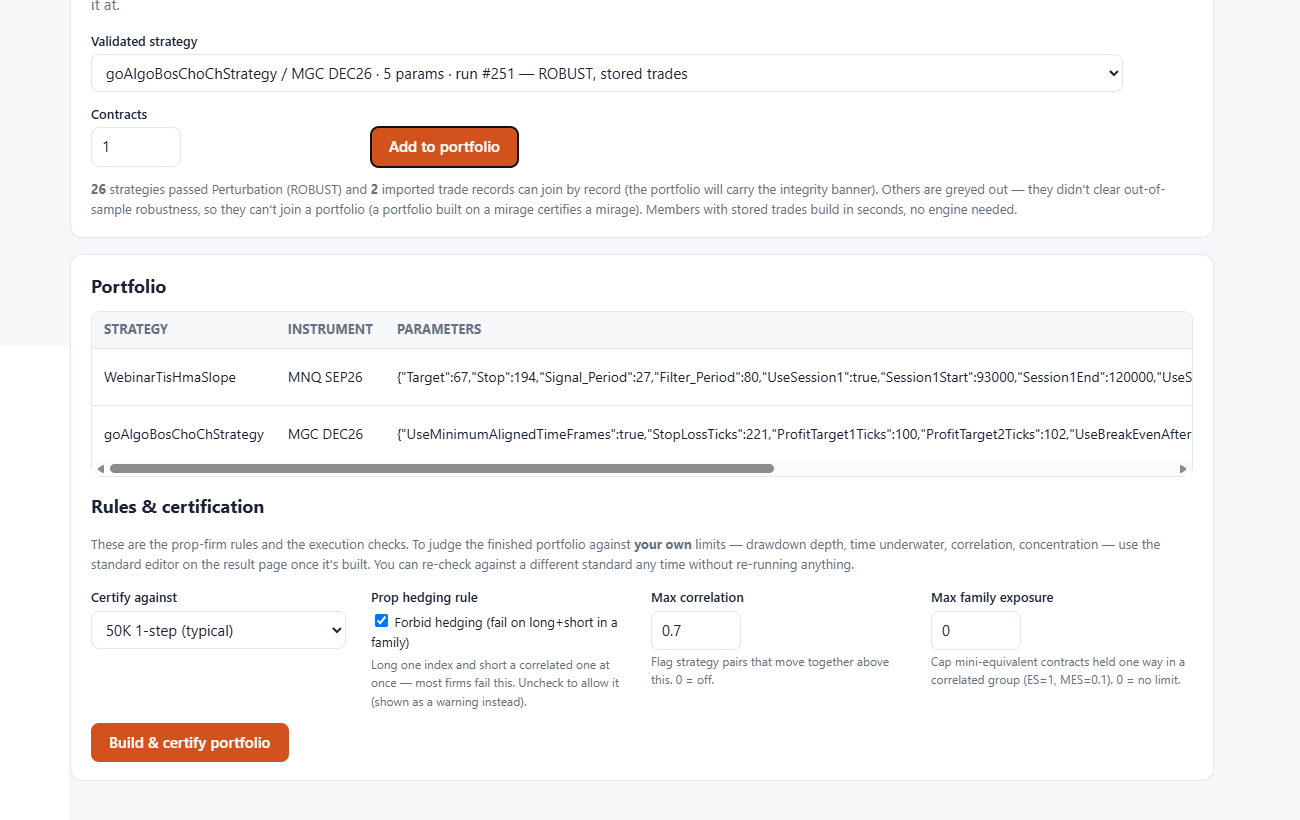
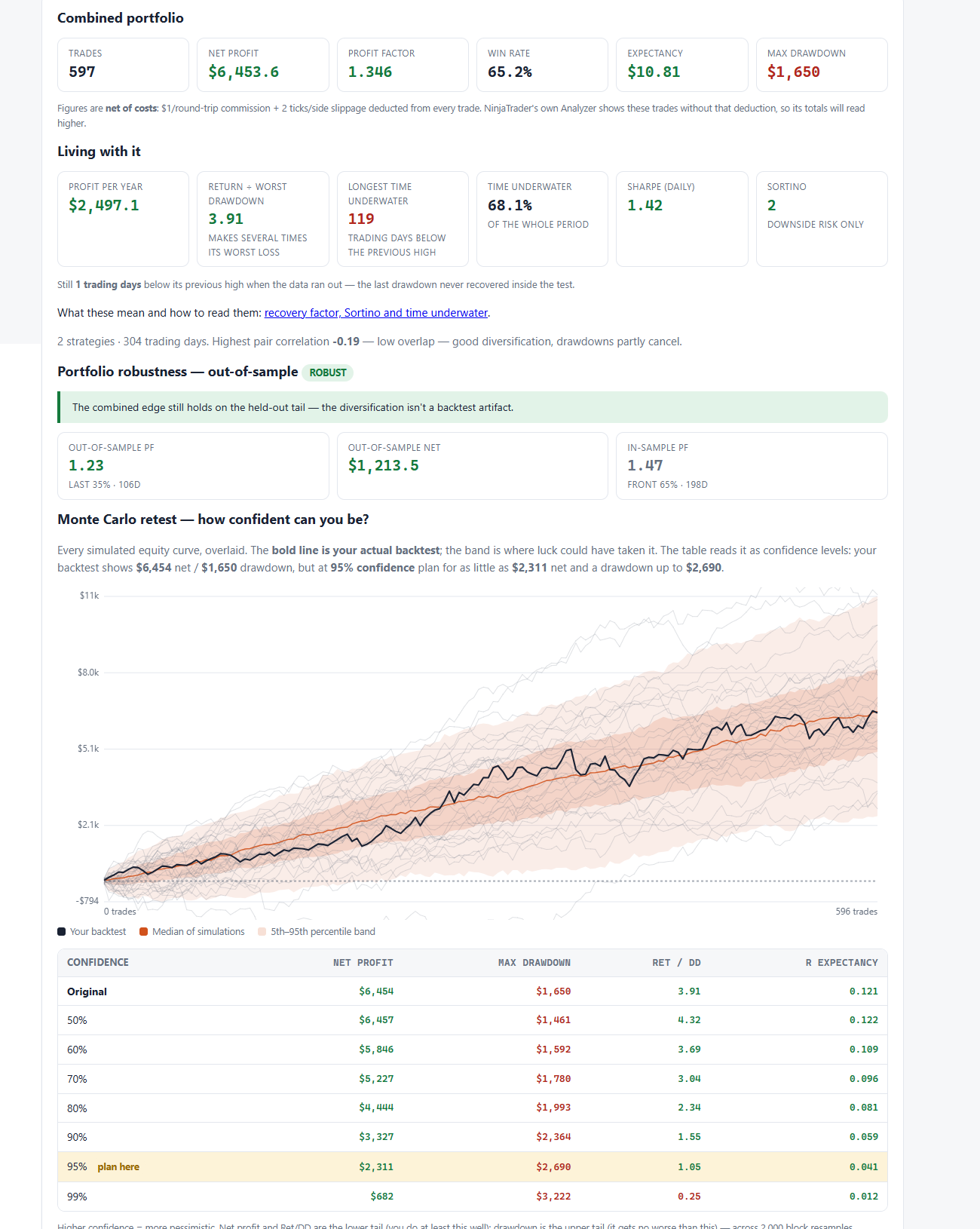
The book, described. One contract each; rules: no opposing positions,
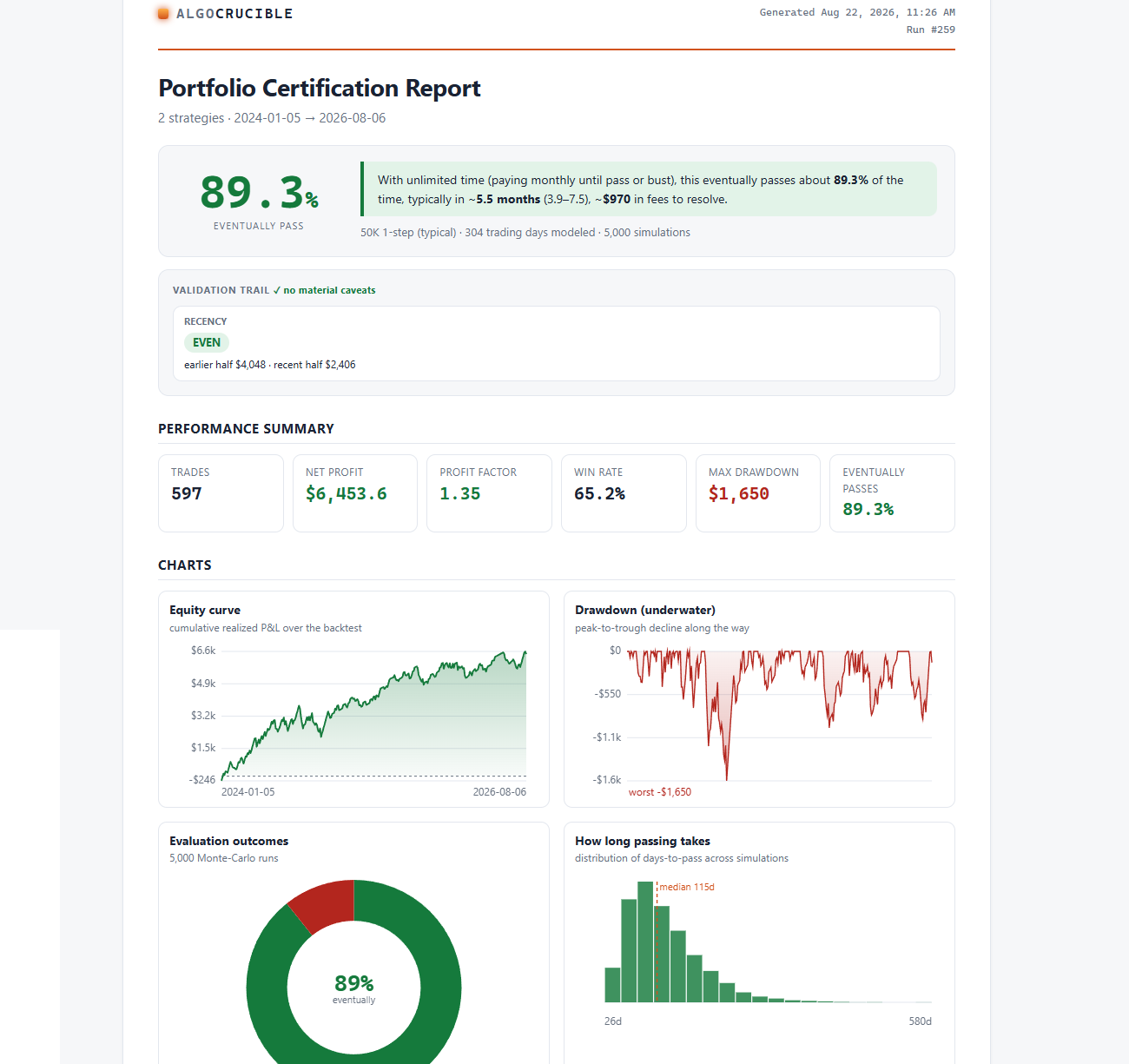
pair correlation under 0.6. Both members came in on their stored trades — the build took one second.One equity curve. 597 trades, net +$6,454 after $1/round-trip commission and 2 ticks a
side of slippage, profit factor 1.35, worst drawdown $1,650 — with the worst stretch underwater drawn, not
just totalled. Correlation of daily P&L −0.19. The held-out tail (last 35%) graded robust on
its own (PF 1.23).
7/Living with it
Totals don't tell you whether you would have kept trading it. These do.
What holding it would have felt like. 119 trading days was the longest stretch below
a prior high; 68% of the period was spent below one; net profit ran to 3.9× the worst drawdown; daily
Sharpe 1.4, Sortino 2.0. How long underwater, how much return per unit of worst drawdown, how the daily
swings compared with the drift. These are the numbers that
decide whether you would actually sit through a bad quarter — and they are the numbers your own
standard, next, is written in.
8/Certify against your own standard
You set the rules. Not a prop firm's — yours: the account it trades in, the return that justifies the
work, the drawdown you would actually tolerate, the months underwater you would wait out, how much of
the profit may come from one member. The standard is saved and judged against the portfolio
walk-forward — the out-of-sample procedure — because that is the evidence that wasn't fitted.
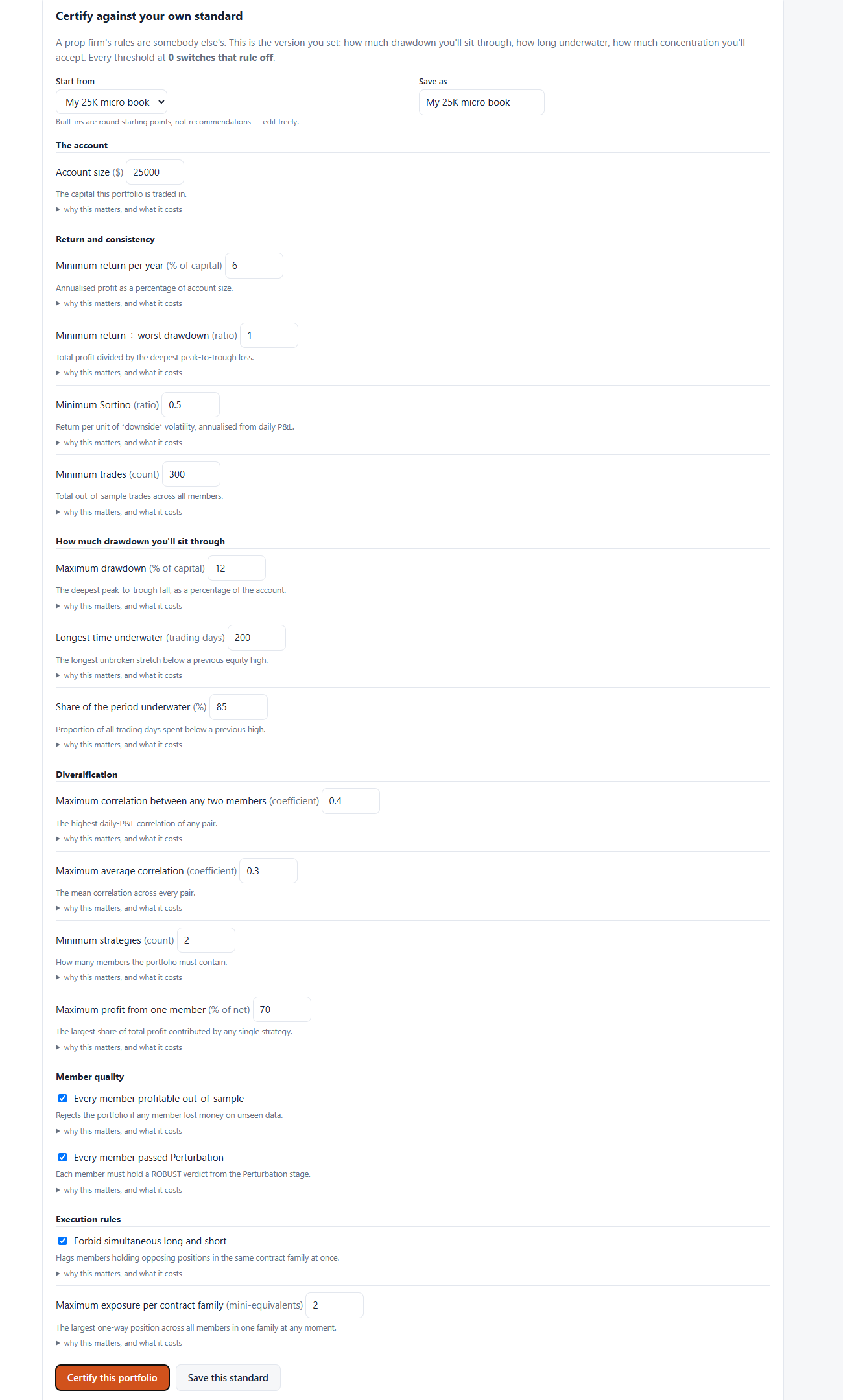
"My 25K micro book". A $25,000 account; at least 6% a year; net profit at
least equal to the worst drawdown; drawdown under 12%; no stretch underwater longer than 200 days and
no more than 85% of the period below a prior high; pair correlation under 0.4; at least two members,
none earning more than 70% of the profit, every one profitable and Perturbation-passed; no hedging.
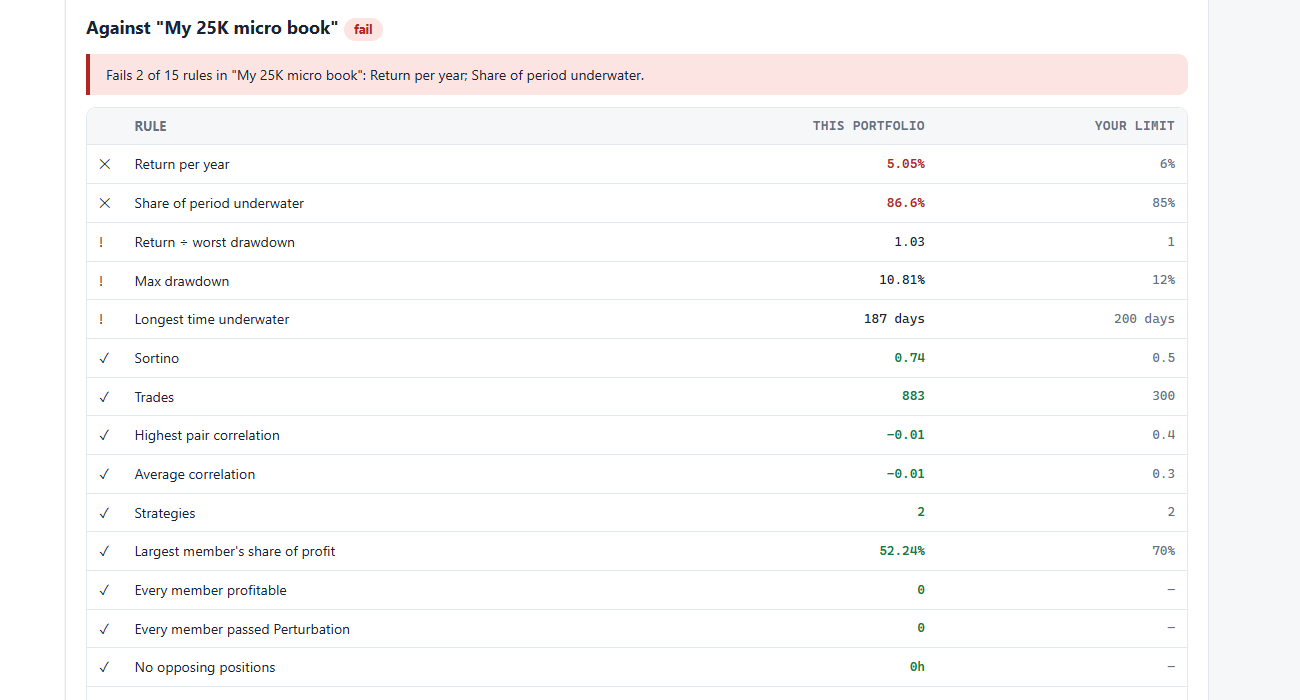
Each rule on the form explains what it measures and what tightening it costs.FAIL — 2 of 15. Return per year 5.0% against the 6% bar; 86.6% of the
period spent below a prior high against 85%. Three more rules passed by a hair (recovery factor 1.03,
drawdown 10.8%, 187 days underwater). Diversification and member quality all clear. This is the
honest reading: a combination with a real joint edge that doesn't yet earn its place on this
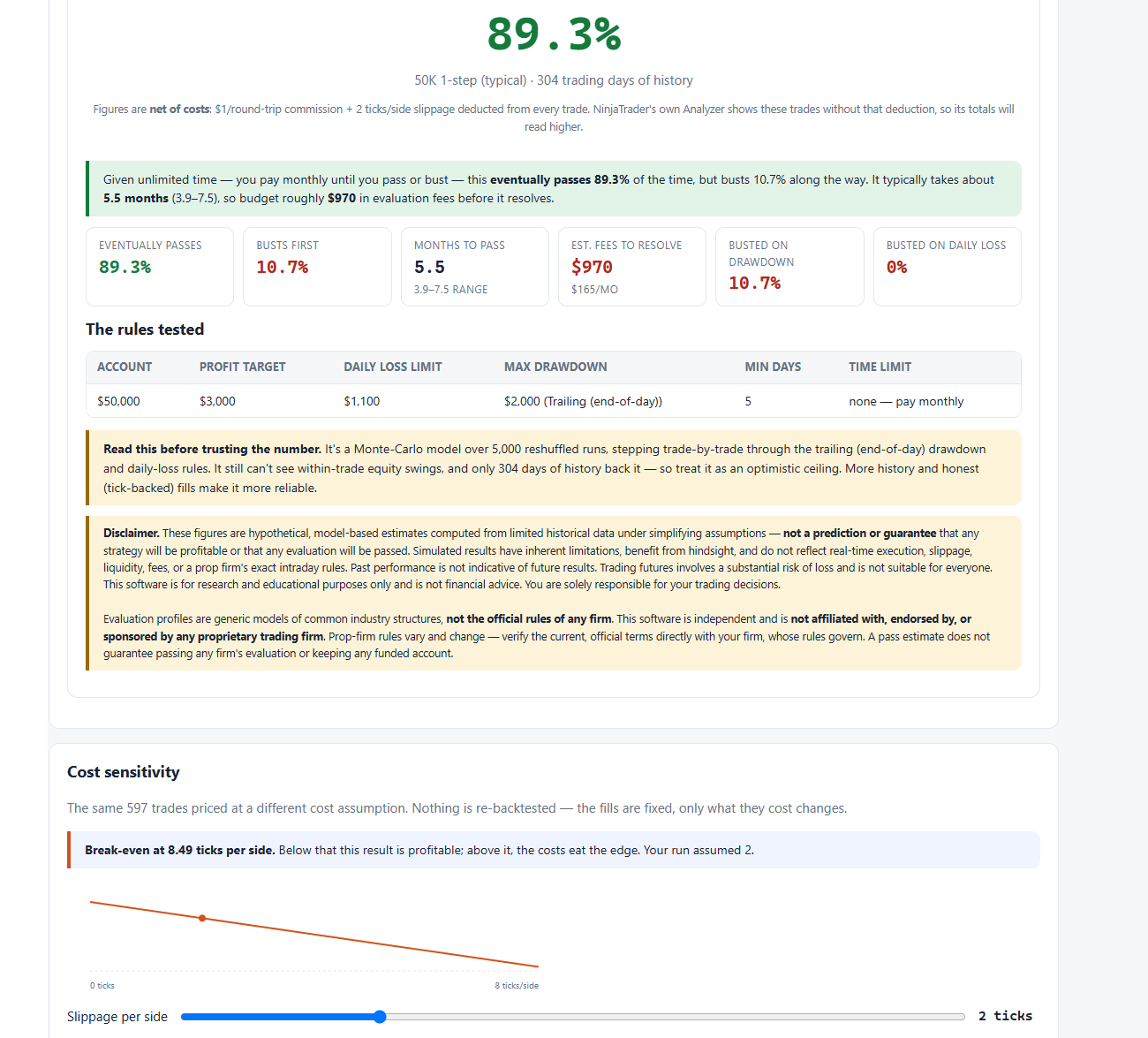
account at these sizes — and the screen says exactly which bar it missed.And against a prop firm's rules, for contrast. The same fixed book through a
50K one-step evaluation model: pass odds 89%, bust risk 11% (all of it trailing drawdown), a median of
5½ months to target. Below it, the cost-sensitivity slider: the book breaks even at about 8½ ticks a side
— the result survives four times the slippage it was priced at. Both are estimates from history, not predictions — and the fact that a book can clear a prop
preset and miss your own bar is the point of writing one.
9/The report
Everything on one document — members, their settings, the verdict each one earned, the correlation,
the rules tested and the odds — with the methodology and its limits stated on the page.
Save as PDF. The full-parameter settings appendix records every input of
every member as captured when the runs started — so the document describes what was tested, not what
you remember testing.
∴Which route is yours?
If you'll re-optimize on a schedule
The portfolio walk-forward is your evidence. You are not trading a setting, you are
trading a procedure — re-fit every N days, trade what comes out — and the out-of-sample curve,
correlation and your standard's verdict describe that procedure. Run it again when you change the
schedule or the members.
If you'll set parameters once
Then the fixed portfolio is the thing you trade, and every member must earn its seat with a
ROBUST perturbation first. Certify the book against your own standard, and against any evaluation
you intend to sit — and re-certify when a member's neighbourhood stops holding.
The reasoning behind the two routes, and why a walk-forward result is never a deployable
configuration, is in the Help Center: Two routes to a
portfolio.
Build your own book
The full pipeline — Optimize, Walk-forward and Audit — is free for 30 days on up to 3 strategies.
Perturbation, portfolios and certification are in the Trader plan, which covers two computers — validate
on the laptop, assemble on the desktop.
Results shown are hypothetical, model-based estimates computed from limited historical
data under simplifying assumptions — not a prediction or guarantee that any strategy or portfolio will
be profitable or that any evaluation will be passed. Evaluation profiles are generic models of common
industry structures, not the official rules of any firm; AlgoCrucible is independent and not affiliated
with, endorsed by, or sponsored by any proprietary trading firm or by NinjaTrader. Trading futures
carries a substantial risk of loss and is not suitable for everyone. Not financial advice.
Risk Disclosure: Futures and forex trading contains substantial risk and is not for every investor. An investor could potentially lose all or more than the initial investment. Risk capital is money that can be lost without jeopardizing one's financial security or lifestyle. Only risk capital should be used for trading and only those with sufficient risk capital should consider trading. Past performance is not necessarily indicative of future results.
Hypothetical Performance Disclosure: Hypothetical performance results have many inherent limitations, some of which are described below. No representation is being made that any account will or is likely to achieve profits or losses similar to those shown; in fact, there are frequently sharp differences between hypothetical performance results and the actual results subsequently achieved by any particular trading program. One of the limitations of hypothetical performance results is that they are generally prepared with the benefit of hindsight. In addition, hypothetical trading does not involve financial risk, and no hypothetical trading record can completely account for the impact of financial risk of actual trading. For example, the ability to withstand losses or to adhere to a particular trading program in spite of trading losses are material points which can also adversely affect actual trading results. There are numerous other factors related to the markets in general or to the implementation of any specific trading program which cannot be fully accounted for in the preparation of hypothetical performance results and all of which can adversely affect trading results.