Walk-forward: does the edge survive data it never saw?
Walk-forward re-tunes the strategy on one slice of history, then tests it on the following slice it had never seen — repeated across the whole data set. Only the unseen slices count toward the result.
The combined out-of-sample result
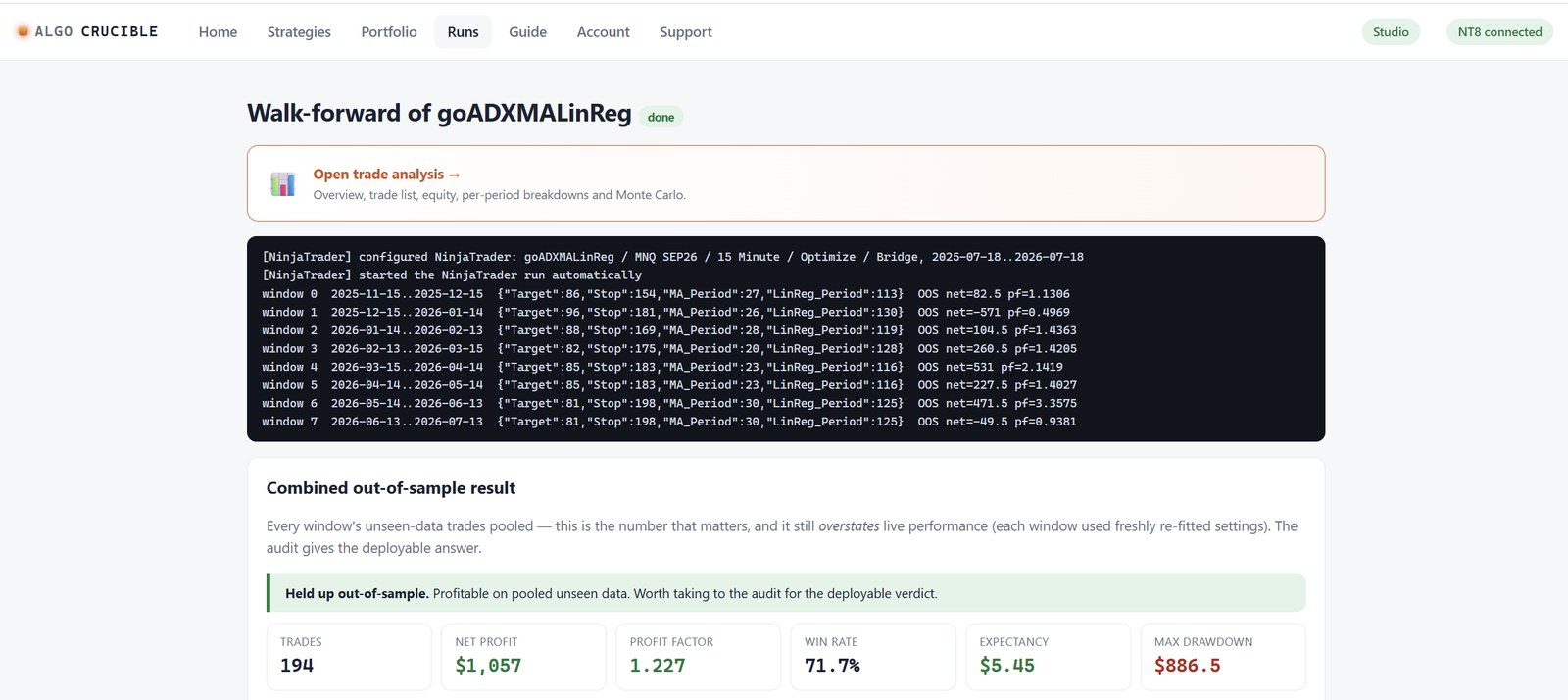
Expect this number to be smaller than the optimizer's — that's what an honest test looks like. (In the walkthrough example: profit factor 1.407 in the search, 1.227 pooled out-of-sample, still profitable → worth taking to the audit.) It still overstates live performance, because each window used freshly re-fitted settings; the audit gives the deployable answer.
Setting stability across windows
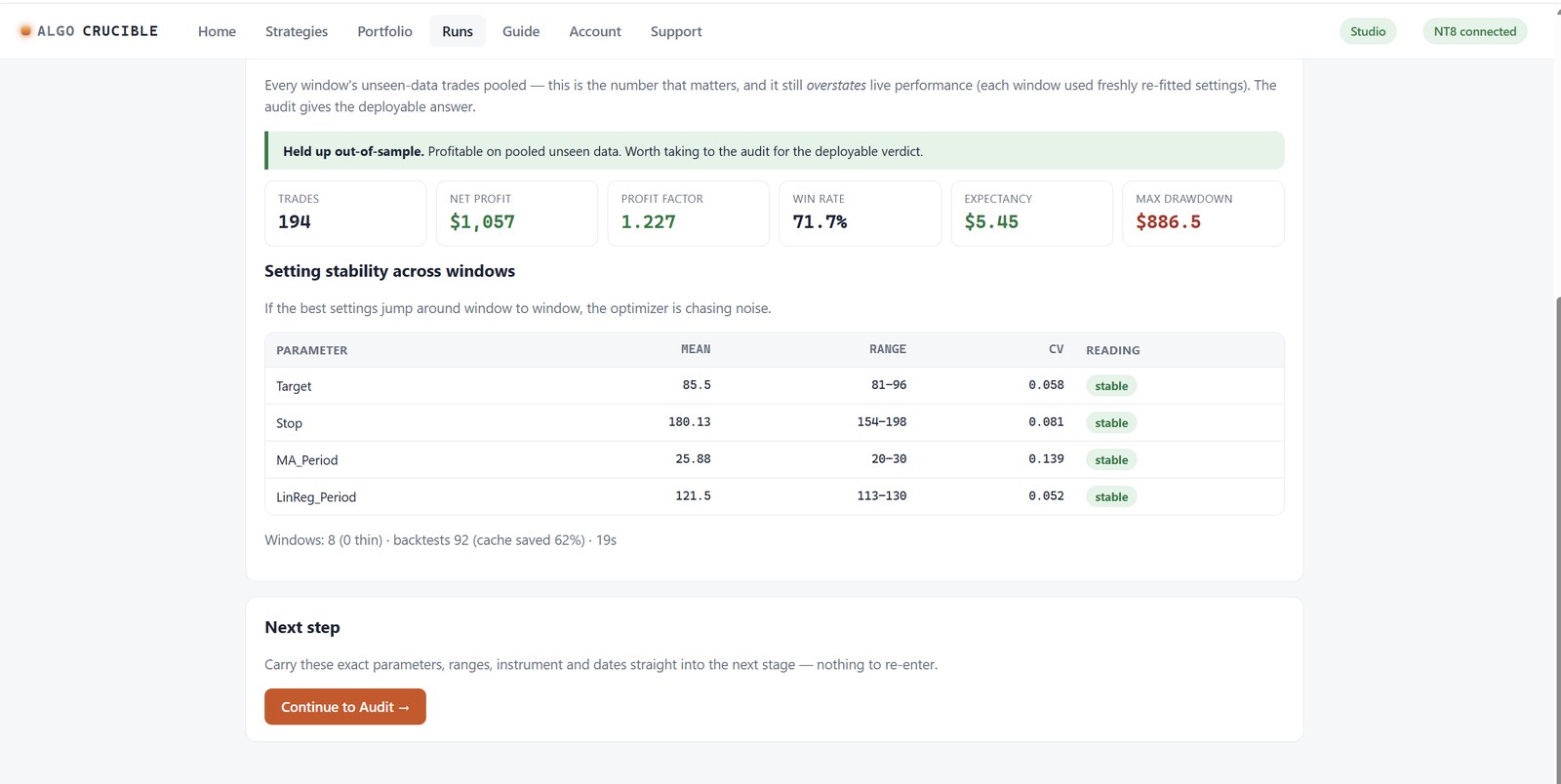
If the best settings jump around wildly from window to window, the optimizer is chasing noise — the "edge" needed a different strategy every few months. Settings that stay in a tight band (graded stable) are a sign the edge is repeatable.
"Thin windows": the refusal before any window runs
Before the windows run, one backtest measures how often the strategy trades. If the learn or grade windows would hold fewer trades than the minimums, the run refuses and says which windows or date range would work, and what the rate was measured at. Continuing from an optimization probes at that run's best setting; a walk-forward started on its own probes at the middle of the search ranges, where some strategies barely trade. To run anyway, set "Thin windows" to allow in the Walk-forward box on the strategy page, or press "Run again, allowing thin windows" on the refused run's page. The result is then marked THIN WINDOWS: a verdict built on few trades, knowingly.