How to Avoid Overfitting a Trading Strategy
Published 2026-07-20 · AlgoCrucible
Overfitting is the reason most "profitable" backtests fail live. It isn't a rare bug or a sign of a careless developer — it's the default outcome of optimizing anything against historical data. This article explains how to recognize it before it costs money, and the specific tests that separate a fitted illusion from a real edge.
What overfitting actually is
Every market history contains patterns that were pure chance — clusters of trends, lucky session times, coincidental level bounces. An optimizer cannot tell the difference between structure and coincidence; it just maximizes the score. Give it freedom (parameters, ranges, combinations) and it will happily tune your strategy to the coincidences.
The result is a strategy fitted to that particular past — a mirage. It backtests beautifully for the same reason a key fits the lock it was cut from, and it fails forward for the same reason that key opens nothing else.
The uncomfortable corollary: a great backtest is not evidence of an edge. The optimizer produces great backtests from noise as a matter of course. Evidence has to come from somewhere the optimizer never touched.
The warning signs
You can often smell overfitting before running a single validation test:
- Many free parameters. Every parameter you optimize is another dimension in which noise can be fitted. Five optimized parameters over wide ranges can "find" almost anything.
- Few trades. 40 trades can't support conclusions about anything. Small samples make coincidences look like edges — and optimizers hunt coincidences.
- Knife-edge settings. The strategy works at a period of 23 but not 21 or 25. Real market effects are not that precise; noise is.
- A too-perfect equity curve. Straight lines with no drawdown usually mean the optimizer found and dodged every historical loss — something it can only do in hindsight.
- All the profit in one stretch. If one regime (often the most recent) carries the result, the "edge" may just be a description of that regime.
The defenses, in the order they should run
1. Give the optimizer less freedom
The cheapest defense is structural: optimize only the parameters you're genuinely unsure about, over ranges that make trading sense. Fixing a parameter at a sane default is often better than letting the search use it as another degree of freedom for fitting noise.
2. Walk-forward: test on data the settings never saw
Walk-forward analysis re-tunes the strategy on rolling windows and grades each window's winner on the data that came next. Only the unseen-data result counts. Expect degradation; what you're checking is whether the edge survives at all — and whether the chosen settings stay stable from window to window. Wildly jumping settings mean the optimizer was chasing noise the whole time.
3. Audit one fixed setting on separate unseen periods
Live trading deploys one parameter set, so test exactly that: freeze the winning settings and grade them on two separate out-of-sample periods, taking the worst of the two. This kills the subtle cheat of "the strategy works as long as it's freshly re-tuned" — and it's where most survivors of the previous steps die.
4. Perturbation: plateau or cliff edge?
A real edge is robust to small changes — nudge every parameter ±10–20% and it should still work. A fitted illusion only works at the exact values the optimizer chose.
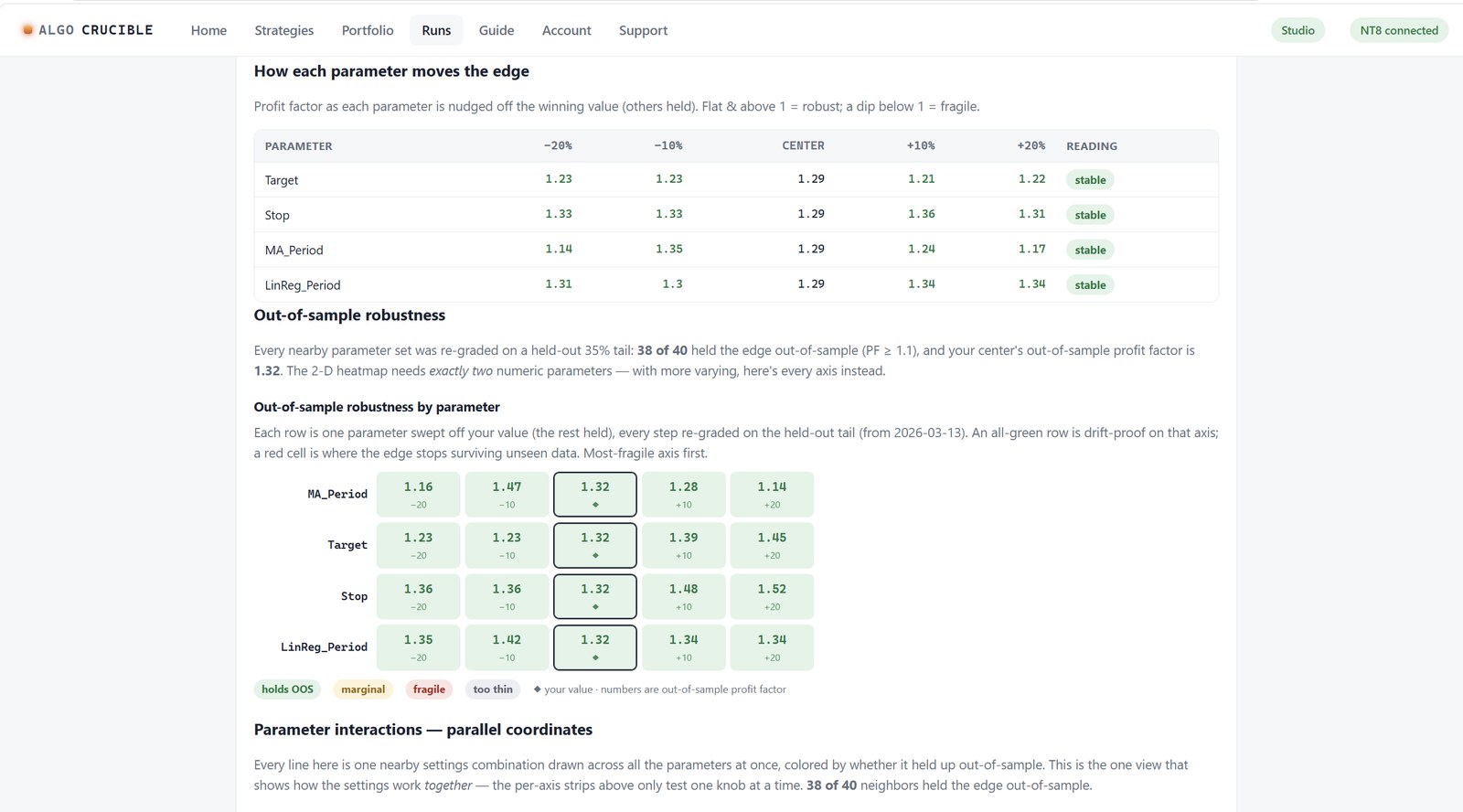
Test dozens of nearby parameter combinations and re-grade each on held-out data. What you want is a green plateau — the neighborhood holds, not just the center point. A lone good setting surrounded by failures is a cliff edge, and live markets push you off cliffs.
5. Monte Carlo: separate the edge from the sequence
Reshuffle the trade order thousands of times. If the strategy only looks good in the order history happened to deal — profitable overall but underwater in a large share of reshuffles — sequencing luck, not edge, made the backtest. The reshuffled distribution also tells you the drawdown to actually plan for (the 95th percentile, not the backtest's).
What passing actually looks like
A strategy that survives all of this looks worse on paper than the original backtest — smaller profit factor, deeper planned-for drawdown — and that's the point. The numbers are smaller because the flattery has been removed. A modest, stable, plateau-sitting, sequence-robust edge is worth infinitely more than a spectacular fitted one, because only one of them exists outside the data it was born in.
The mental model that keeps you honest: optimization is the audition, not the verdict. The verdict comes from the data the optimizer never touched — and most strategies fail it. That failure isn't the process being harsh. It's the process working: every mirage caught in simulation is an account that didn't get burned proving it live.
AlgoCrucible automates this whole funnel for NinjaTrader 8 strategies — Bayesian optimization, walk-forward, fixed-set audit with blunt ROBUST/MIRAGE verdicts, perturbation plateau maps, Monte Carlo, and prop-firm certification, all driven by NinjaTrader's own backtest engine. Watch a real strategy run the gauntlet in the illustrated walkthrough, or download it free.
Simulated results are hypothetical and have inherent limitations; past performance does not indicate future results. Trading futures involves substantial risk of loss. Nothing here is financial advice.