Why Your Backtest Doesn't Match Live Trading (and What Actually Fixes It)
Published 2026-07-20 · AlgoCrucible
It's the most common disappointment in systematic trading: the backtest earned steadily for two years, you go live, and within a month the account looks nothing like the chart. The usual reaction is to blame execution or bad luck. Sometimes that's right. More often, the gap was baked into the backtest before the first live order — and it was detectable in advance.
Here are the six causes that explain almost every backtest-versus-live gap, in rough order of how much damage they do, and what actually defends against each.
1. Overfitting — the big one
If you optimized your strategy's settings on the same data that produced the beautiful backtest, the backtest is circular: the settings were chosen because they fit that history. The market that generated the history doesn't owe those settings anything going forward.
Overfitting isn't an edge case — it's the default outcome of optimization. An optimizer's whole job is to fit the past; whether anything real was captured is a separate question the backtest itself cannot answer.
Defense: never judge a strategy on the data that tuned it. Use walk-forward analysis to test settings on data they never saw, then audit one fixed parameter set on separate unseen periods. If the out-of-sample result collapses, the backtest was a mirage — better to learn that in simulation than with margin.
2. Sequencing luck — your backtest is one shuffle of the deck
A backtest shows one ordering of trades. The same trades in a different order produce the same final profit — but wildly different drawdowns, losing streaks, and account survival. If your live start happens to draw the losing cluster first, the "same" strategy feels broken.
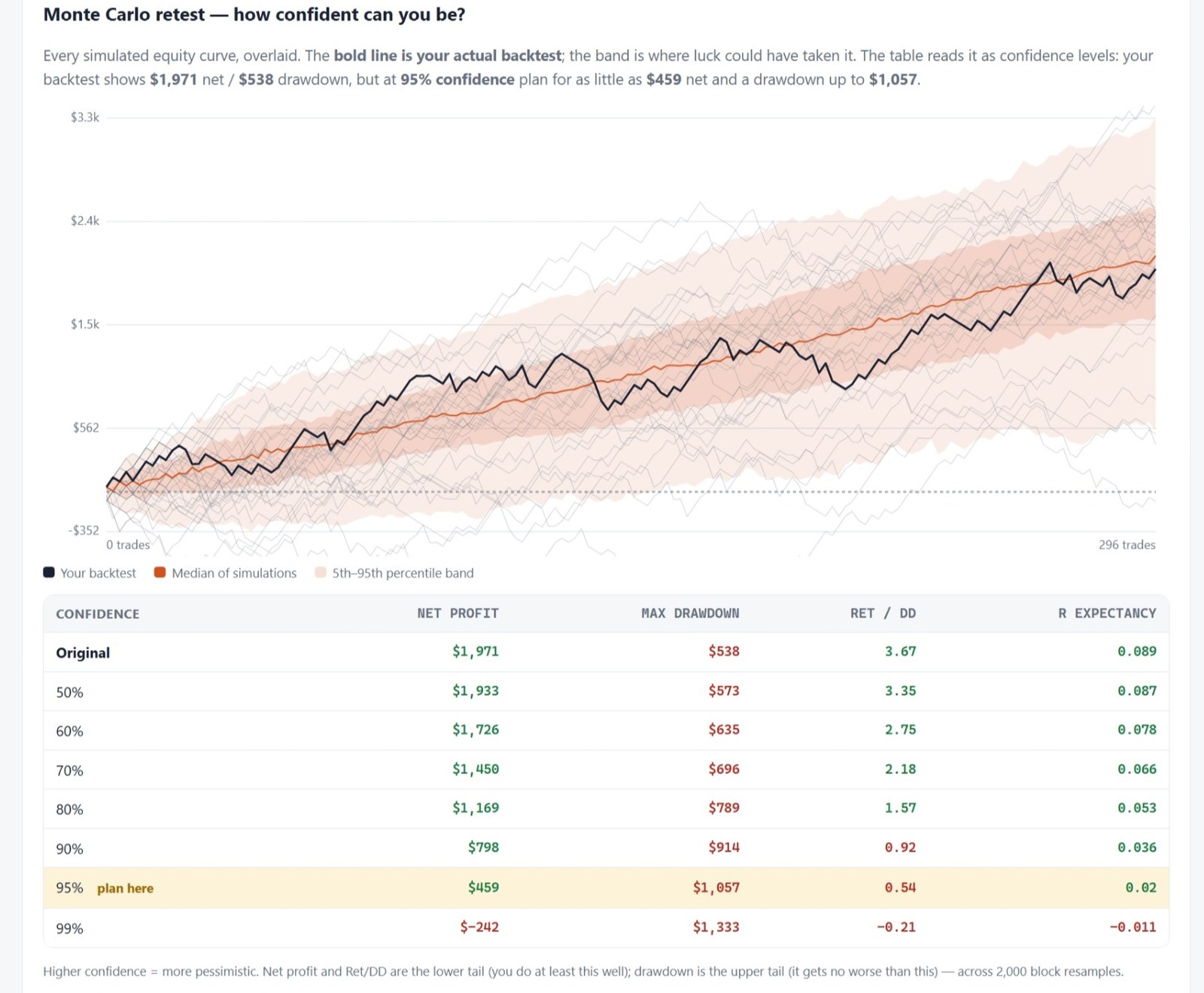
Defense: Monte Carlo resampling. Reshuffle the trade sequence thousands of times and look at the distribution: the 95th-percentile drawdown, not the single backtest's drawdown; the range of final results, not the one you happened to get. In the example above, a backtest showing a $538 max drawdown carries a 95%-confidence drawdown of $1,057 — nearly double. A live month that would have shocked the backtest reader is completely ordinary inside the fan.
3. Costs and slippage the backtest didn't pay
Commission and slippage are small per trade and enormous in aggregate, especially for high-frequency or thin-edge strategies. A strategy netting $8 per trade before costs doesn't survive $4 of round-turn commission plus a tick of slippage.
Defense: model costs in the backtest — your broker's actual round-turn commission and at least one tick per side of slippage on market orders. If the edge disappears under realistic costs, it was never deployable. (Limit-order strategies have the opposite problem: the backtest assumes fills you won't always get. Treat backtested limit fills at the exact touch with skepticism.)
4. Data and simulation artifacts
Bar-based backtests guess what happened inside each bar. Fill assumptions on stops and targets inside the same bar, spread handling, and look-ahead bugs (using the bar's close to decide an entry at its open) all flatter results. Exotic bar types (Renko and friends) are particularly prone to fills at prices that never traded.
Defense: backtest on the same engine and data that will trade live where possible, sanity- check intrabar fill assumptions, and treat any strategy whose edge depends on perfect stop-and- target fills inside single bars as unproven.
5. Regime change — the market moved on
Some strategies genuinely work, then stop: volatility regimes shift, a session's character changes, correlated flows dry up. A backtest averaged over years can hide the fact that all the profit came from one regime — often the most recent one, which is exactly what an optimizer locks onto.
Defense: check when the profit was earned. If the earlier half of the history is flat and the recent half carries everything, you have a recency-weighted edge and should expect it to be fragile. Parameter-stability checks across walk-forward windows catch the same disease from a different angle.
6. You — the execution gap
The backtest never hesitated after three losses, never widened a stop, never skipped the 6 a.m. signal. Live, a discretionary override during the first drawdown converts a surviving strategy into a losing one. This cause is real but overdiagnosed: it gets blamed because it's flattering, when causes 1–5 usually did the damage.
Defense: size positions off the Monte Carlo drawdown distribution (so the first bad streak is expected, not shocking), and validate thoroughly enough that you actually trust the system when it's losing — trust built on evidence survives drawdowns; trust built on one backtest doesn't.
The pattern behind all six
Notice what the defenses have in common: none of them is "get a better backtest." They're all ways of asking harder questions than the backtest asked — unseen data, reshuffled sequences, realistic frictions, fixed settings, stress. A backtest that hasn't faced those questions isn't evidence; it's an audition.
AlgoCrucible runs this exact gauntlet — optimize, walk-forward, fixed-set audit, parameter perturbation, Monte Carlo, and prop-firm certification — against NinjaTrader 8's own backtest engine, with costs modeled throughout. See a real strategy survive all six stages in the illustrated walkthrough, or download it free.
Simulated results are hypothetical and have inherent limitations; past performance does not indicate future results. Trading futures involves substantial risk of loss. Nothing here is financial advice.