The validation funnel — and the two places it leads
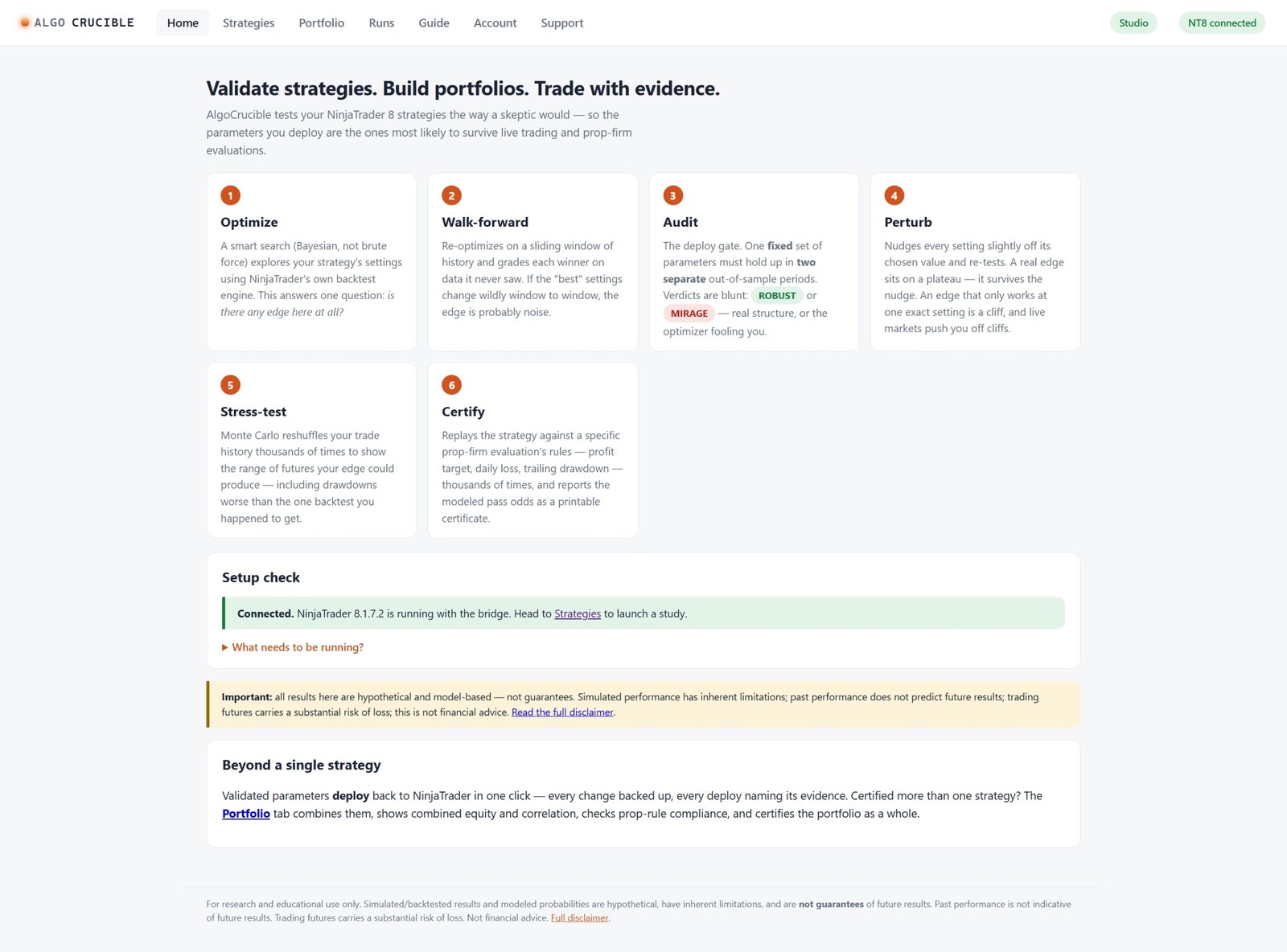
AlgoCrucible runs your NinjaTrader 8 strategy through a funnel of six stages. Each stage asks a harder question than the last, and strategies drop out along the way — that's the tool doing its job. Most backtesting software exists to make your strategy look good; this exists to find out whether it actually is.
Every number in every stage is produced by NinjaTrader 8's own backtest engine on your data — AlgoCrucible drives it through a bridge add-on and keeps the evidence. Results are shown net of costs: commission and slippage are deducted from every trade, and each panel says exactly what was deducted. A strategy that only works at zero friction isn't a strategy, and the app won't present one as if it were.
The six stages
- Optimize — is there any edge here at all? (the audition, not the verdict — the search samples the space rather than sweeping it, on purpose)
- Walk-forward — does the edge survive data it never saw?
- Audit — does ONE fixed setting hold up in two separate unseen periods? (ROBUST or MIRAGE)
- Perturbation — does the edge sit on a plateau, or a cliff edge?
- Monte Carlo stress-test — what could luck have done to the same trades?
- Certification — the modeled odds against a specific prop-firm evaluation's rules
Then the funnel forks: two destinations
Validation is the same for everyone — a real edge is a real edge. What you do with a validated strategy depends on how you trade.
Route one: certify it for a prop-firm evaluation
You have one strategy, usually intraday, and you want to know your realistic odds against a specific firm's rules before paying the evaluation fee. The certification stage models your strategy's daily P&L against the profit target, daily-loss limit, trailing drawdown and time limit of the firm you pick, and prints the odds on a report you can keep — or send.
The illustrated end-to-end walkthrough: algocrucible.com/certification.html
Route two: build a portfolio you can live with
You trade swing or higher-timeframe systems, and no single one of them is the point — the point is a basket of uncorrelated strategies whose combined equity curve is steadier than any member's. For this route the app adds, on top of the six stages:
- Portfolio analysis that combines validated strategies, shows their correlation, and prices the whole basket at each member's own costs.
- Two honest ways to test a portfolio — walk-forward validates the procedure of re-fitting members on a schedule; the fixed portfolio validates one setting. They answer different questions, and which one is honest for you depends on what you'll actually do live.
- Your own standards, not just a prop firm's — define the drawdown, consistency and durability limits a basket must meet, and certify against those.
- "Living with it" numbers — recovery factor, Sortino and time underwater: what holding the thing would have felt like, which the totals never tell you.
- A position cap — what happens to the basket when you can only hold so many positions at once. The answer is a lower bound: the cap can only remove trades that were taken, never invent new ones.
The question behind every stage
However you trade, the funnel keeps asking one thing: would this have made money on data it never saw, at costs it would really pay? Optimizing answers almost nothing by itself — an exhaustive search over millions of combinations will always find something that fit the past. The stages after it exist to take that something away unless it's real. Strategies failing here is the product working; the cost-sensitivity view will even tell you exactly how much slippage your edge can survive, which is usually a better question than what the P&L was.
Stage-by-stage articles: - Setup & picking a strategy - Configure & Optimize - Walk-forward - Audit — the ROBUST verdict - Perturbation & Monte Carlo - Certification — your pass odds
Reading your results: - How thorough is the optimization? - Cost sensitivity — how much slippage the edge survives - The two portfolio routes - Durability — recovery factor, Sortino, time underwater
All results are hypothetical, model-based simulations — not predictions or guarantees. Trading futures carries substantial risk of loss.